During its first fiscal year under new CEO Ralph Hamers, UBS Group AG (“UBS”) exceeded analysts’ expectations as it continued to show strong revenue momentum buoyed by a rebound in economic activity. Following its strong financial performance, the bank has raised its guidance for return on common equity tier 1 capital to 15% – 18% and set a loftier profit target by promising to cut underlying expenses for the current financial year.
Financial and credit highlights
For the quarter ended 31 December 2021 (‘‘4Q21’’), UBS posted USD 1.36b in net profit, which was significantly lower than 3Q21 (~41% quarterly decline). On a year-on-year (“YoY”) basis, 4Q21 profit before tax (‘‘PBT’’) was approximately 13% lower compared to 4Q20. This was largely due to an increase in litigation provisions regarding their cross-border wealth management business and personnel expenditures, which drove up their total operating expenses by 14% YoY. Excluding litigation provisions, its 4Q21 operating expenses would have only increased 2% from a year ago, which translates to a 24% year-on-year gain in 4Q21 PBT.
For the full year ended 31 December 2021 (‘‘FY21’’), PBT increased 16% to USD 9.48b with a return on common equity tier 1 capital (‘‘RoCET1’’) of 17.5%. This marks a slight improvement from its FY20 RoCET1 of 17.4% despite the increase in litigation provisions.
Its solvency position also improved compared to a year ago due to net credit loss releases, with CET1 capital ratio at 15.0% for FY21, marking 120 basis points (‘‘bps’’) higher than 2020. Following the recent acquisition of Wealthfront, a digital wealth management provider that mainly caters to millennials and Gen Z investors, the Swiss bank expects a slight decline of its CET1 ratio by 40 bps. Nonetheless, their CET1 capital ratio remains well above its requirements even with the reactivation of the countercyclical capital buffer by the Swiss National Bank.
After the global financial crisis and rogue trader scandal in 2011, UBS has made a clear decision to trim its investment banking operations and center itself around its wealth management advisory services. Today, it is the largest private banking institution in the world, accounting for approximately half of the world’s billionaires as its clients. Total invested assets of the bank, which measures the volume of client assets deposited with or managed by UBS for investment purposes, grew to USD 4.6t in FY21. This marks a 9.8% increase from the previous year, largely supported by its Americas region which saw the highest growth in invested assets across all regions.
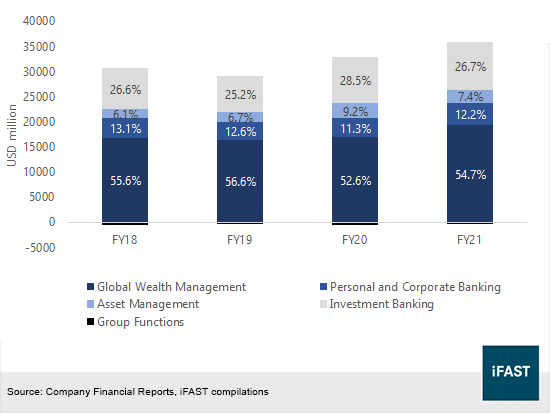
Across different business segments in FY21, UBS’ Global Wealth Management division takes up the largest portion of total operating income at approximately 54.7% (Figure 1). Of which, its recurring net fee income grew 19% YoY and takes up approximately 57.4% of the entire division’s operating income. This is largely positive for the bank, as it creates a consistent and predictable stream of income even if transaction volumes or net interest income were to decline in the future.
For FY21, its wealth management division saw an inflow of USD 107b of net new fee-generating assets across all regions. Going forward, their acquisition of Wealthfront will also help to broaden their reach to high net worth and ultra-high net worth investors in the US region and leverage on their wealth management capabilities to grow its business and expand its fee-generating assets.
Figure 1: Total Operating Income Breakdown
Its Personal and Corporate Banking (“P&C”) division posted the highest year-on-year increase among other divisions in total operating income for FY21 (~19.1%). This is largely due to net credit loss releases, as the total volume of delinquent or bad debt declined in FY21 due to the broad economic recovery. Net interest income, which contributes almost half of the division’s operating income, improved slightly by 3.5% compared to a year ago.
This year, it is widely expected that most central banks will start tightening their monetary policies. This will likely benefit UBS as it forecasts that higher interest rates will boost its P&C division net interest income by USD 100m to USD 300m (assuming a 1% parallel shift in yield curves). Meanwhile, its wealth management division also expects an increase in USD 700m to USD 1.5b (assuming a 1% parallel shift in yield curve) in net interest income this year.
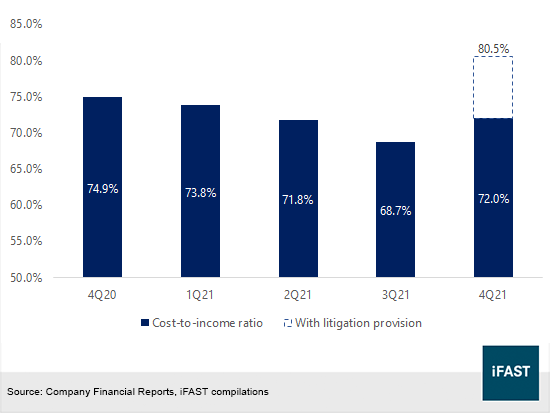
Despite the litigation provisions, UBS managed to keep its cost-to-income ratio below 74% for FY21 (FY20: 73.3%, FY21: 73.6%). For FY22, the bank has set a target for its cost-to-income ratio to fall to a range of 70% - 73%. The bank has been disciplined in cutting down expenses and managing its costs over the past year to support its growth plans. Excluding the litigation provisions, cost-to-income ratio for 4Q21 would have been 72.0%, which is an improvement compared to a year ago (Figure 2).
Going forward, UBS aims to achieve approximately USD 1b of cost savings by next year to continue funding its growth initiatives. It plans to leverage on technology to reduce cost-to-service and deliver automated client experiences with digital onboarding capabilities to improve overall productivity. Its acquisition of Wealthfront is a testament to its digitalization initiatives, as UBS hopes to scale its Global Wealth Management division to a broader client base through fast, efficient, and advise-centric digital services for its clients.
Figure 2: Cost-to-income ratio
Overall, UBS has presented strong earnings results for FY21, exceeding analysts’ estimates and surpassing its own targets set for the year. The bank is well-capitalized with a notable 120bps improvement in CET1 ratio compared to FY20, while liquidity coverage ratio also improved by 3 percentage points year-on-year. Regarding the litigation provision, UBS has filed an appeal with the French supreme court in hopes of reducing the overall penalty that it was instructed to pay. For FY22, the bank has boosted its financial targets to 15% - 18% return on CET1 capital and 10% – 15% growth in PBT for its Global Wealth Management division. As such, UBS remains well on track to drive higher returns for its stakeholders in this current financial year.
Features of the UBS 7% perpetual USD bond
The UBS 7.000% Perpetual Corp (USD) has its first call and reset date on 31 January 2024 and is resettable every 5 years thereafter. The coupon of the bond will be reset based on the 5-Year US mid-market swap rate plus a margin of 434.4 bps. As of 16 February 2022, the bond has a yield to call of 4.16% with an issue rating of ‘Baa3’/‘BB’/’BBB’ (Moody’s/S&P/Fitch).
Coupon payments on the perpetual bond can be deferred and is non-cumulative. We should also note that the issuer may choose to redeem the perpetual bond in whole but not in part, on the first call date. If UBS decides not to call back the bond, the coupon will then be reset based on the rate mentioned above. Typically, there are a few determining factors for an issuer to redeem its notes.
Firstly, it depends on how well-capitalized the issuer is closer towards the call date. If the issuer does not have sufficient liquidity and capital, it is unlikely that they will call back the bond as that will further strain its liquidity and credit profile. Usually, when issuers intend to call back their existing notes, it provides investors with an assurance and confidence that the company still has healthy financials and credit metrics. However, we should note that there were some issuers in the past who chose not to call back their notes even though they were not in a credit distressed situation.
Secondly, it depends on whether it is economical for the issuer to redeem its existing notes and refinance them at a lower coupon rate. It is likely for an issuer to call back its bonds if they can issue a new security at a lower credit spread. For certain bonds with high step-up margins in their reset rates, it is also highly likely for the issuer to call back the bonds and refinance them at a lower interest rate.
Besides the issuer call option, the perpetual bond also has a loss absorption feature where the full principal and any accrued interest of the security will be written down to zero if UBS’ CET1 ratio falls below 7.0%. Perpetual bondholders will no longer have rights against the issuer for the repayment of principal or accrued interest on the bond if such an event is triggered.
Following the global financial crisis, many banks and financial institutions have become more mindful and conservative in managing their capital. For a global systemically important bank (“G-SIB”) like UBS, it has built-up sufficient capital buffers over the years to withstand systemic events within the economy and protect its solvency in the event of unforeseen downside risks. Thus, with a current CET1 ratio of 15.0%, it is unlikely for UBS to experience the trigger write-down event in the near future. Nonetheless, investors who are looking to invest in its perpetual bonds should recognize the contingent write-down event risks and exercise proper discretion.
Relative valuations
We compare UBS against other banks that have similar CET1 ratios, along with theiroutstanding AT1 bonds.
Table 1: Banks with comparable CET1 ratios
|
FY21 |
CET1 Ratio (%) |
|
UBS Group AG |
15.0 |
|
Julius Baer Group Ltd |
16.4 |
|
Credit Suisse Group AG |
14.4 |
|
Deutsche Bank AG |
13.2 |
|
BNP Paribas S.A. |
12.9 |
|
Credit Agricole S.A. |
11.9 |
|
Société Générale S.A. |
13.7 |
| Source: Bloomberg Finance L.P., iFAST compilations. As at 31 December 2021 | |
Among other comparable banks, UBS has one of the highest CET1 ratio for FY21 at 15.0% (Table 1), reinforcing its financial and solvency strength as one of the largest financial institutions in the world. If we were to compare its 7% perpetual bond to other securities with a remaining year to call of 1 to 3 years, we find that the UBS 7% perp is attractive as it has one of the highest yield to call (“YTC”), only falling behind the UBS 5.000% Perpetual Corp (USD) and BAERVX 4.875% Perpetual Corp (USD) (Figure 3).
Figure 3: Relative valuation of designated AT1 instruments
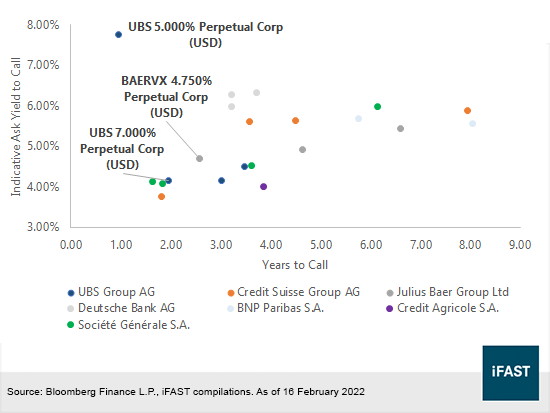
Notably, while the UBS 5.000% Perpetual Corp (USD) looks very attractive with the highest YTC and shortest time to call date, we should be mindful of the non-call risks of the bond. The coupon will be reset on 31 January 2023 based on the US 5-Year mid-market swap rate plus a margin of 243.2 bps. Referencing to UBS’ latest perp issues, the bank recently issued a 4.875% perpetual bond in January 2022 with an initial spread of 340.4 bps. This is approximately 100 bps higher than the reset margin of the UBS 5.000% Perpetual Corp (USD). Therefore, if the bank decides to call back the 5% perpetual bond and refinance it, UBS will likely have to refinance at a wider spread, which is rather uneconomical and costly for them.
Conversely, the UBS 7.000% Perpetual Corp (USD) has a reset spread of 434.4 bps, which is approximately 100 bps higher than the initial spread of the latest perpetual bond issue. We think that there is a higher chance for the bank to buy back the UBS 7.000% Perpetual Corp (USD) so that UBS can refinance it at a lower coupon rate.
Nonetheless, if earnings growth and economic recovery continue to show a strong momentum this year, we can expect a tightening of its credit spreads and UBS will be able to issue new bonds at similar yields relative to its existing perpetual securities. This may increase the probability of calling back the UBS 5.000% Perpetual Corp (USD).
Comparing the UBS 7.000% Perpetual Corp (USD) with the BAERVX 4.750% Perpetual Corp (USD), even though the BAERVX 4.750% perp is trading at a higher YTC (4.70%) compared to the UBS 7% perp, we think that the trade-off between the shorter time to call for the UBS’ bond (~0.6 years) and a lower YTC (~54 bps) is fair. Both Julius Baer and UBS have similar credit ratings. Julius Baer is rated ‘Baa1’ (by Moody’s) while UBS is rated ‘A-‘/’A+’ (S&P/Fitch). However, in terms of top and bottom-line growth, UBS has outperformed Julius Baer over the past few years and continues to cement its position as the largest private bank in the world.
Conclusion
Following a strong FY21 result, the bank is on track to perform even better this year, as it has raised its financial targets to deliver higher returns for its stakeholders. With a CET1 ratio of 15.0%, the group has ample liquidity to meet its financial liabilities and sufficient regulatory capital buffers to withstand financial stress. Therefore, investors who are looking for a security yielding higher than 4% and backed by a strong and stable issuer may consider the UBS 7.000% Perpetual Corp (USD).
Declaration: For specific disclosure, at the time of publication of this report, IFPL (via its connected and associated entities) holds positions in UBS 5.875% Perpetual Corp (SGD), and the analyst who produced this report holds a NIL position in the abovementioned securities.
Our podcast series, Yield Hunters, is available on Spotify, iTunes Podcasts and Google Podcasts. We share our thoughts on new bond issues and hold discussions on the fixed income space. Listen to our latest episode below and follow us!